Stereo Non-Line-of-Sight Imaging
Pablo Luesia-Lahoz, Sergio Cartiel, and Adolfo Muñoz
Visual Computer 42, 148 (2026).

Abstract: #
Transient non-line-of-sight imaging techniques reconstruct hidden scenes by analyzing the time of flight of light scattered off a visible secondary surface, or relay wall. Despite many promising approaches, all face the inherent problem of the missing cone, which restricts surface visibility based on their position and orientations relative to the relay wall. Drawing inspiration from stereo technologies from computer vision, we devise a setup consisting of two distinct relay walls. We leverage phasor fields that computationally model both relay walls as generalized virtual camera apertures. This approach allows us to combine the contributions from each relay wall, including the signal obtained by illuminating one wall and capturing the other, information that would be lost otherwise. Our results demonstrate that our proposal diminishes the effect of the missing cone by making the problem better posed. Additionally, by analyzing the visibility conditions of the missing cone, we extract orientation cues from each relay wall contribution. We use this information to enhance visualizations.
Results: #
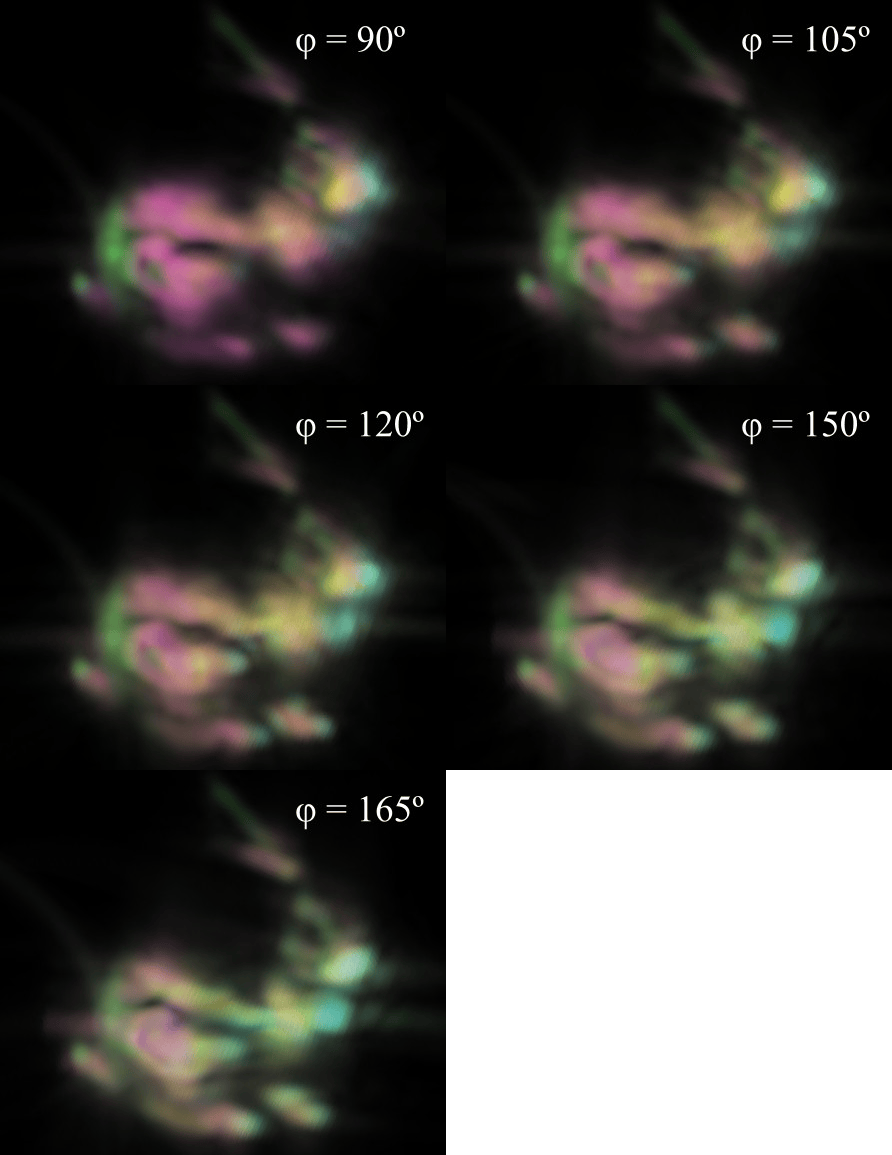
We can color code the contribution of each relay wall to the reconstruction: